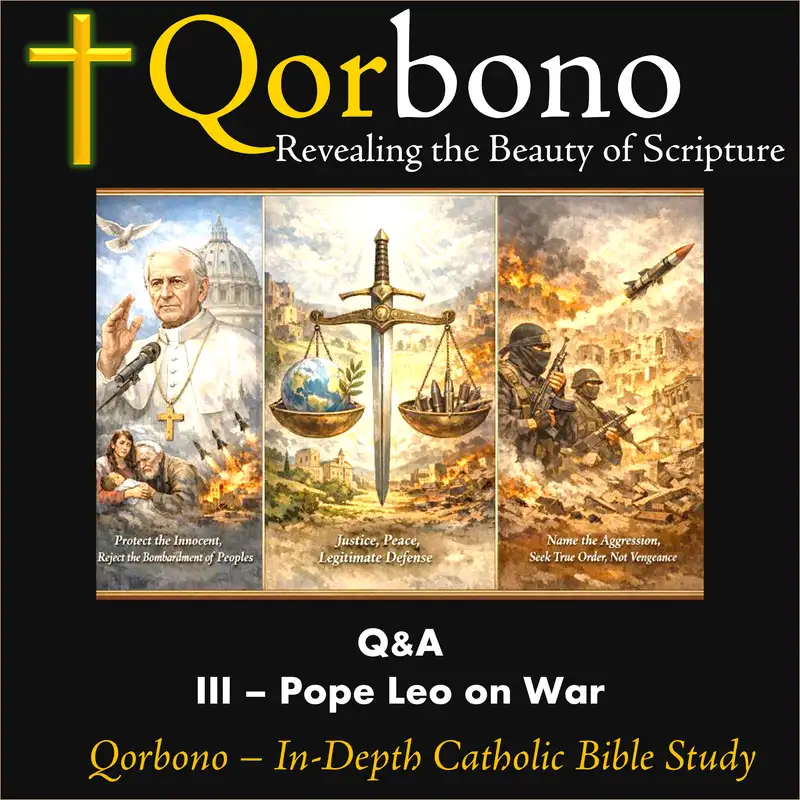
Q03 - Pope Leo on War
00:01
Good evening and welcome to this Corbono Q &A. Today's question is a difficult one. When Pope Leo calls for war with Iran to stop, is he asking us to accept evil? Is he in effect capitulating to Iran and to the proxy system that has done such damage in Lebanon? That question matters and I should begin with a personal disclosure. I am a Maronite Catholic born in Lebanon, so the subject is not abstract for me.
00:26
I approach it with a personal stake, with love for my country, with an awareness of wounds that many people only know from headlines. But let us begin with the immediate context. After President Trump publicly escalated the crisis of Iran, warning in extreme terms that a quote, whole civilization will die tonight, Pope Leo reacted forcefully. On April 7, 2026, he said that a threat against the entire people of Iran was truly matter of international law.
00:54
but also a moral question concerning the good of peoples. Then on April 11, he denounced the quote, delusion of omnipotence that fuels war. on April 13th, he said he would continue to speak out loudly against war, promote dialogue and seek just solutions. That provoked immediate controversy. Some said the Holy Father was simply stating the obvious threats against whole peoples.
01:22
attacks on civilians and the intoxication of war must be condemned. Others said he was naive, one-sided or functionally capitulating to Iran and to Hezbollah. So the real question is not whether war is bad in the abstract. The real question is whether Pope Leo's words align with Catholic teaching on justice, legitimate defense, civilian protection, sovereignty and peace, and whether his message is complete or truncated.
01:53
To understand that question, need a brief map of the conflict. Iran is a Shiite Muslim-led state that over roughly four decades built a regional network of allied movements and militias, often called the Axis of Resistance. That network includes Hezbollah in Lebanon, armed Shiites group in Iraq, the Houthis in Yemen, and Hamas, whose power base is in Gaza, though it also has a significant presence in the West Bank. This...
02:22
is one reason the conflict is so tangled. It is not a simple bilateral dispute between Israel and Iran or between the United States and Iran. It's a regional struggle in which Iran has projected power through non-state actors, especially where the local state is weak, as in Lebanon.
02:41
For our purposes, Hezbollah is especially important. It was founded by Iran's Revolutionary Guards in 1982 and has long been armed, financed, and guided by Iran. Effectively, Hezbollah is a state within a state and it really answers to Iran and not to the Lebanese state. Over time, it has grown into something like, like I said, a state within a state in Lebanon and that is part of the wound here. Lebanon's sovereignty has been compromised not only by external attack but also by internal usurpation. So for instance, not too long ago,
03:11
But I would say three weeks ago, the Lebanese government asked the ambassador of Iran to leave and the ambassador refused. He simply refused the direct order from Lebanese state hiding behind the might of Hezbollah. There's also the question of Iran's posture toward Israel. Iran does not recognize Israel. Iranian leaders have repeatedly used language, not merely of opposition, but of eradication.
03:39
alongside the ideological conflict runs the nuclear one. For years, Israel and Western governments have argued that Iran's nuclear program could lead to a bomb, while Iran has denied seeking nuclear weapons and said this program is peaceful. Under the current American presidency, now this brings us to the point at hand here, this came to a head on February 28, 2026, when Israel said it had launched a preemptive strike on Iran and reports stated that US strikes were also underway.
04:07
Operation was framed as an effort to remove threats to the state of Israel amid the long running nuclear dispute. Now I would also argue that for the United States, the war with Iran can be rightly construed as a proxy war with China. But I'm not going to cover this right now. I'm just going to stay focused on the question at hand, is whether the statements that Pope Leo made accord with Catholic teaching or not.
04:33
Now the war widened further Hezbollah entered the conflict on March 2nd and Israel opened a major front in Lebanon in response. So when we speak of the war with Iran we also have to keep in mind the war Israel is waging against Iran backed Hezbollah on Lebanese soil. So to sum it up you've got the fact that Hezbollah has been that Iran has been extending its power through the region to protect all the Shia people connecting them
05:02
to the axis of resistance. You have the fact that they have been accused of building a nuclear bomb, which they have denied. You have their posture against Israel, which has been said in a language that is extremely violent. And then you have the conflict directly with United States of America regarding their posture with a nuclear bomb. All of that, all that tangle makes it for a complex situation.
05:29
With that background in place, we can state the issue more fairly. Staying away from the hubbub of media, Pope Leo's public remarks were not, first of all, an ex cathedra definition, nor were they a new dogma proposed for the ascent of the faith. At the same time, Catholics should not treat papal moral judgments flippantly. We may, I would say we must, evaluate them respectfully, carefully, and reverently.
05:59
Now here is what I think is the Achilles heel in how Pope Leo's message lands. In the remarks that triggered this controversy, he spoke very directly against threats to the Iranian people and against attacks on civilian infrastructure. Still, he did not, in those same remarks, speak with equal directness about Iran's long-standing sponsorship of proxy violence.
06:28
Hezbollah's role in dragging Lebanon into war. Because of that asymmetrical view or if you will unbalanced statement many people hear the message as morally asymmetrical. They hear Israel is rebuked in detail, the United States is rebuked in detail, Iran and Hezbollah are handed more obliquely or almost get a free pass. Now I don't necessarily ascribe to this the mere fact that the message that Pope Leo had put out is not complete.
06:58
does not mean it's wrong. And that's very important. Nevertheless, that criticism is not irrational, but it is not the end of the matter. A missing condemnation of one party does not automatically make a true condemnation of the other party false. Let me repeat that. A missing condemnation of one party does not annul the condemnation of the other or make it false. If a man rebukes the burning of a village, the rebuke does not become false simply because he failed.
07:28
in that same breath to recount the crimes that preceded the burning of the village by the villagers. It may be incomplete. It may be rethought rhetorically lopsided, but it does not cease to be morally true on that account. In other words, you need to consider every act on its own. And that brings us to the teaching of the church. The church does not teach absolute pacifism. Understand that church never said you should never take part in a war. The catechism.
07:56
and Gaudium and Spitz both affirm that governments may exercise lawful self-defense once peaceful means have failed. So the Church does not say that nations must simply collapse before aggression, but that right of defense is hemmed in by strict moral conditions. Catechism says the damage inflicted by the aggressor must be lasting, grave, and certain. Other means must have failed.
08:26
there must be serious prospects of success for the war and the user force must not create evils greater than the evil being resisted. So I repeat all that. One.
08:43
damage inflicted by the aggressor must be lasting, grave and certain. While that's not absolutely clear, at least not directly clear in the case of Iran, there's a lot of posturing and potential, potential for long lasting harm, but it's not straightforward and clear. Other means must have failed. Well, in that case, we've seen diplomacy with the Iranians go on and on and we have
09:11
clear indication that they've dug their heels and they're refusing to consider the posture that was given to them and the controls that were put on them have not slowed down their ability to construct their own weapons and their own ballistic missiles. Now one might argue that that in and of itself does not constitute an evil greater than Israel having its own nuclear bombs or the United States having its own missiles.
09:39
Every country has a right for self-defense, which is the Iranians have claimed. Nevertheless, that posture has always been very ambiguous, particularly because they've armed these proxies and they have disregarded the authority of other states. oh Even once. Okay. The use of force must not create evils greater than the evil being resisted. So on the whole, if you end up producing evil, killing innocent people,
10:09
far more than the initial evil would have caused, then that war may not be considered just. Civilians must be protected and uh the moral law remains in force. Acts of indiscriminate destruction are condemned and in modern conditions the church has become even more skeptical about whether wars can truly satisfy these standards. Fratelli Tutti says
10:36
that in our age it is very difficult to invoke the old rational criteria for a just war. It doesn't mean that you cannot have a just war. It just says that the modern weaponry makes it more challenging. So with all that in mind, does Pope Leo's fit Catholic teaching? In large measure, yes. His insistence that threats against an entire pop people are an unacceptable fit to church's rejection of indiscriminate or collective violence. You can have as head of state
11:04
simply proclaim that tomorrow a whole civilization is going to be wiped out. That, from a Catholic standpoint, is not a just statement. His warning about attacks on civilian infrastructure fits the Church's insistence that war remains under moral law. His appeal for dialogue and ceasefire aligns with the Church's demand that war remain a last resort, not a first instinct. And his language about the delusion of omnipotence fit the Christian diagnosis that pride, vengeance, and the intoxication of power are among the spiritual roots of war.
11:35
Now his March 15 statement about Lebanon is also important. did not merely say stop fighting. He said he hoped for dialogue that would support Lebanon's authorities in implementing lasting solutions for the good of all the Lebanese people. So he was not equating peace with passivity. He was at least an outline pointing toward the restoration of rightful authority, particularly the rightful authority of Lebanese state. And yet the answer is not simply yes, full stop. Popio's words
12:04
fit one major side of the Catholic tradition very well. The protection of civilians, the rejection of escalation, the suspicion of war. But they do not express the whole of the tradition with equal force. The Church also teaches the right of lawful self-defense. The duty to protect the innocent and the need to restore political order. That particular one, the last one, resonates very strongly with me. The need to restore political order. In this controversy, Leo spoke with great clarity about what must not be done to the Iranian people
12:34
than about Iran's long strategy of proxy warfare, Hezbollah's violation of Lebanese sovereignty, or the claims of lawful defense that Israel and others would invoke. That doesn't make him wrong in his assessment of the American posture specifically when the president declares the whole civilization is going to get wiped out, but it makes the rhetoric vulnerable. It makes the statement easier to hear as one-sided, especially
13:03
for all of these questions and others who live close to the consequences of Hezbollah in Iran.
13:08
So what is the real answer? The question is whether Pope Leo contradicts Catholic teaching, I would say no. This condemnation of collective threats, civilian suffering and intoxication of war fits the Catholic tradition very well. The question is whether he expresses the whole Catholic doctrine on war in a full and balanced way, I would say not entirely. His public rhetoric in this controversy emphasizes peace, restraints civilians.
13:35
and dialogue more strongly than emphasizes lawful defense, naming races and dismantling the unjust structures that helped produce the war in the first place.
13:47
um So the most accurate judgment is this from my perspective anyways Pope Leo's statement is doctrinally sound and substance but authorically incomplete in application. Now if you think about it the Pope has a whole world to manage so he addressed one side but that doesn't mean he willfully ignored the other there could be so many other things on his plate. Having said that it is unfortunate
14:15
that the way his statement resonates seems to indicate that he is somewhat ignoring the responsibility that falls squarely on Iran and the evil they have committed.
14:32
That I think is the point at which the matter becomes clear. The Holy Father is not capitulating to evil. is insisting that even real evil does not license unlimited war. He's warning that a just cause does not justify unjust means. I'm going repeat that. A just cause never justifies unjust means. He's reminding the world that the bombardment of people, destruction of civilian life, and the intoxication of power are not redeemed by the wickedness of one's enemy. Catholics who feel uneasy are not necessarily being partisan or hard.
15:01
Hard-hearted their unease often comes from the sense that a fully Catholic account must also name the aggressions Proxy statements systems and disorders that made the war possible the ceasefire without justice can become merely an intermission in violence in other words if let's say Tomorrow there is a ceasefire with Iran Iran will immediately begin rebuilding Its axis of resistance rearming Hezbollah and we're back to where we started with a whole bunch of people who died
15:30
a lot of violence and destruction and no change in peace or justice. And so the Catholic task is harder than slogans from either side. It is to seek a peace that protects the innocent, restrains evil, restores legitimate authority and does not let vengeance masquerade as righteousness. The church does not ask us to bless surrender. She asked us to seek a just peace without letting war become its own false gospel. Now,
16:00
That might be harder than one might think because it requires us to look back inwardly and fight with our own demons, fight with our own vices and our tendencies to lash out because things out there in the world are not going our way. Nevertheless, we should always remember in all of this conflict that the Lord Jesus Christ is Lord of Lords, King of Kings, and nothing escapes his authority.
16:28
And so we must turn to Him in full faith and confidence, trusting in His justice and in His mercy that in the end He is going to lead all of us to heaven, provided we correspond with Him. I hope this helped you uh better navigate this question. I will be on my website with a podcast. I will be dropping a longer text that does not have this issue in more detail.
16:57
you'll find it there. And as usual, if you have any questions or follow-up questions, please forward them to questions at gorgorono.com. And God bless you.